Tuesday, October 12, 2010

Vancouver Antiquarian Book Fair


I'm pretty excited for this event this upcoming Friday and Saturday. The only problem will be that I'll probably end up having a total fit because I won't be able to buy anything due to my recent self imposed budget restrictions on books. So really it'll be a bitter sweet affair. But I'll compensate by hopefully taking lots of photos and then (also hopefully) posting them.
Here's the link for the site and here's all the important details in case you can't read the text on the flyer above:

Vancouver Public Library
Friday Oct 15th 3pm-9pm
Saturday Oct 16th 10 am-5 pm
$5 admission good for both days


Sunday, October 3, 2010

Mrs Pepperpot


Whilst on the subject of my 'students' teaching ... I was asked by Amber who grew up in England if I knew the series 'Mrs Pepperpot' which I unfortunately did not. I have looked online for more on it, but have not really been able to find out too much about it other than some images of covers. Then I found one cover which looks different from the others leading me to think that as with so many series, the original series was continued by a different illustrator, and thus was never quite the same.... Here are the covers.
They look like they could be a lot of fun. Also, the cover with the original looking illustration was found on a japanese site, selling it right next to a German book I love called 'Die kleine Hexe' (The little witch) by Otfried Preussler who I covered a bit ago, thus making me believe that it has to be awesome ... obviously.... :) I guess I won't know until I get to see a copy.

J.J. Grandville


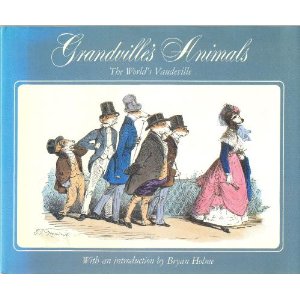
Thanks to one of my 'students' of my Illustration for Picture Books class, I have once again learned something else. This something else is J.J. Grandville. Lynda kindly let me borrow her book 'Grandville's Animals- The World's Vaudeville'. In this book are featured a collection of lithographs from two of Grandville's major books 'The Metamorphoses of the Day' (1829) and 'Scenes from the Private and Public Life of Animals' (1842).

From the introduction by Bryan Holme:
"It has been said that if it hadn't been for J.J. Grandville there would have been no John Tenniel and no Edward Lear. And if it hadn't been for the ancient Egyptian mystics who drew animal heads on human bodies, perhaps there would have been no Grandville either."
"Nothing like this had been seen before: birds, cats, dogs, elephants, tortoises-even beetles-behaving as well as looking like humans. Adding to the novelty of Methamorphoses, which became the rage in Paris, was the new lithography process by which the illustrations were printed. Clothing his animals in the fashion of the day and giving them human airs, gestures, emotions and thoughts, Grandville assigned each of his characters a role in the world's vaudeville" as Charles Blanc so aptly put it."
"Together with the Grimm brothers' collection of fairlytales, which had been published in Germany in 1812 and in England in 1823 under the title of 'Household Stories' Grandville's two books represented milestones in publishing that se the stage for a whole new trend in fairytale and animal story books."
"Grandville was to influence hundreds of illustrators. By 1850s, Charles Bennett had illustrated his bizarre Aesop's Fables, a book which could amost be taken for the work of Grandville, and George Cruikshank was drawing Grandvillesque cartoons like his 'Fellows of the Zoological Society' for The Comic Almanack. In the 1870's Walter Crane's Beast in Beauty and Wolf in Little Red Riding Hood were in the same Grandville genre. Later came Arthur Rackham, and after the turn of the century, Beatrix Potter, and later still Walt Disney and so very many other young illustrators, each depicting animals as humans in his own particular way. Until recently however, the far-reaching influence of Grandville's books was never fully recognized outside France except by artists, illustrators, and connoisseurs. "

"For professional reasons-his father also being an artist- Grandville adopted the stage name of his grandfather, who was an actor of repute. His real name was Jean-Ignace-Isidore Gerard. "
"In 1823 the family scraped enough money together to send him to Paris, where he was to study art and make his own way. Within a short four years his first illustrations, Four Seasons of the human life, were published and and - shortly thereafter, Voyage to Eternity, inspired by Holbein's series of woodcuts The Dance of Death. "
While looking Grandville up I also came across his series of 'Les Etoiles' (The Stars) and 'Les Fleurs' (The Flowers). I have featured a couple of these in the images above. They are pretty unique and I am really glad to have found them! Also, here's a good blog post on Grandville at Love for Books.... and ... here's a good piece giving you a glimpse into a specific image of Grandville's and how to make sense of it. So yeah, thank you Lynda Cameron! Way to teach me something!

Sunday, September 26, 2010

Shaun Tan: 'Who are Picture Books for?'


Here are the first two pages from Shaun Tan's essay 'Picture Books: Who are they for?' You can read the whole essay on his website here.

PICTURE BOOKS: Who Are They For?
By Shaun Tan

"One of the questions I am most frequently asked as a maker of picture books is this:
‘Who do you write and illustrate for?’ It’s a little difficult to answer, as it’s not
something I think about much when I’m working alone in a small studio, quite
removed from any audience at all. In fact, few things could be more distracting in
trying to express an idea well enough to myself than having to consider how readers
might react!

In any case, I suspect that much art in any medium is produced without a primary
concern for how it will be received, or by whom. It often doesn’t set out to appeal to a
predefined audience but rather build one for itself. The artists’ responsibility lies first
and foremost with the work itself, trusting that it will invite the attention of others by
the force of its conviction. So it’s really quite unusual to ask “who do you do it for?”
Yet it is a question inevitably put to my work in picture books such as The Rabbits,
The Lost Thing and The Red Tree, which deal with subjects such as colonisation,
bureaucracy, whimsy, depression and loneliness, typically in a strange or unusual
manner.
The reason of course is quite obvious. The idea of a picture book, as a literary art
form, carries a number of tacit assumptions: picture books are quite large, colourful,
easy to read and very simple in their storyline and structure, not very long and (most
significantly) produced exclusively for a certain audience, namely children, especially
of the younger variety. Picture books are generally put on the shelves of bookstores,
libraries, lounge rooms and bedrooms for young children, where they apparently
belong. Picture books are synonymous with Children’s Literature. But is this is a
necessary condition of the art form itself? Or is it just a cultural convention, more to
do with existing expectations, marketing prejudices and literary discourse?
The simplicity of a picture book in terms of narrative structure, visual appeal and
often fable-like brevity might seem to suggest that it is indeed ideally suited to a
juvenile readership. It’s about showing and telling, a window for learning to ‘read’ in
a broad sense, exploring relationships between words, pictures and the world we
experience every day. But is this an activity that ends with childhood, when at some point we are sufficiently qualified to graduate from one medium to another?
Simplicity certainly does not exclude sophistication or complexity; we inherently
know that the truth is otherwise. “Art,” as Einstein reminds us, “is the expression of
the most profound thoughts in the simplest way.”
And it’s clear that older readers, including you and me, remain interested in the
imaginative play of drawings and paintings, telling stories, and learning how to look
at things in new ways. There is no reason why a 32-page illustrated story can’t have
equal appeal for teenagers or adults as they do for children. After all, other visual
media such as film, television, painting or sculpture do not suffer from narrow
preconceptions of audience. Why should picture books? It is interesting that observe
that when I paint pictures for gallery exhibitions, I am never asked who I am painting
for. "


Tuesday, September 21, 2010

Riquiqui Roudoudou le journal qui se deplie


I found these amazing kids magazine covers at Emma's blog something I stumbled upon while searching for something else as per usual. They are sooo great! Check out the whole entry on the magazine on her blog. Thanks Emma! I now want this magazine very badly.

Sunday, September 19, 2010

Last image reminds me of...


Marc Boutavant illustration I remember seeing... next feature artist will HAVE TO BE MARC BOUTAVANT! One of the best artists in this field today in my opinion.

more Thomas Baas...